When a Place Name Changes Its Spelling
When a place name changes spelling, trace the sound, record and naming convention behind each form to understand how local usage took shape.
A place name can sound unchanged while its spelling shifts from one sign, map, or family letter to the next. To understand why a place name changes spelling, follow the forms in the order people used them: listen for the spoken name, inspect how it was written, and identify the conventions that shaped each record.
This approach helps distinguish an ordinary spelling variation from a formal change, a copying error, or two names that were never quite the same. You do not need specialist software. A notebook, a map, and careful attention to who wrote each form are enough to begin.
What exactly changed?
Start by writing down the forms you have actually encountered. Copy the spelling as printed or displayed, and note where it appeared: a road sign, local directory, map, council document, school record, or family account. Include punctuation, accents, spacing, and capitalization rather than quietly tidying them.
Then ask whether the difference is truly orthographic. St. Anne’s Bay and Saint Anne’s Bay may be two written versions of the same spoken name. But a change from North Ferry to North Ferry Landing may add a distinguishing word, while a change from Ferry to Fairy could reflect a different interpretation of the sound or an error in copying. Similar-looking forms are clues, not proof of a shared history.
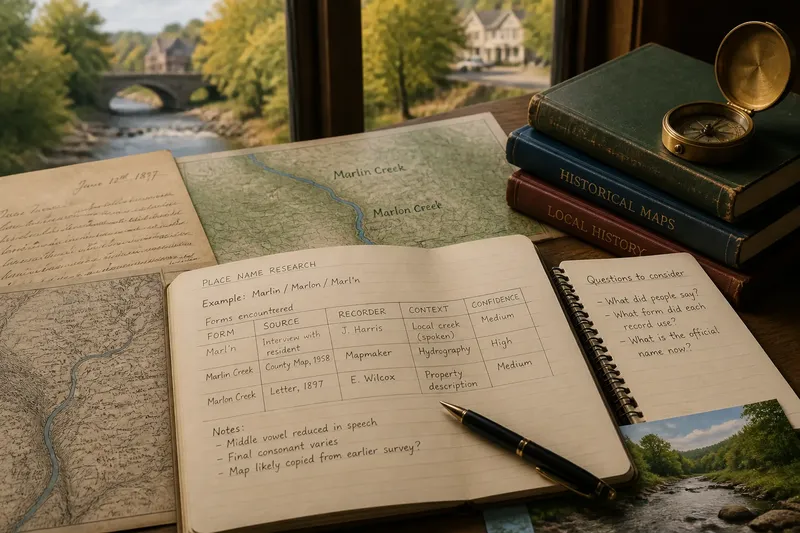
Make a small comparison table, either on paper or in a simple spreadsheet:
- Form: the exact spelling, including marks and spaces.
- Source: where you saw or heard it.
- Recorder: the person, office, or organization responsible, if known.
- Context: what feature or place the name identifies.
- Confidence: whether the form is documented, remembered, or still uncertain.
This table acts like a set of labeled folders: each spelling stays attached to the evidence that supports it. That small discipline prevents a familiar modern form from erasing older evidence before you have examined it.
How does the spoken form guide the search?
Listen to how people who know the place pronounce the name, but do not treat one speaker as the final authority. People may differ by family, neighborhood, age, or language background. Some shorten a name in conversation; others preserve a local vowel or consonant that a sign does not convey.
Record pronunciation in a way you can explain. A plain phonetic note such as “first syllable like ‘bay’” may be more useful than an unfamiliar technical symbol. If you use a phone recording, ask permission and identify the speaker only if they agree. Keep the person’s wording separate from your own interpretation.
Pay attention to sounds that spelling systems handle unevenly. A vowel may have no exact counterpart in English spelling. A final consonant may be softened or dropped in casual speech. A stress pattern can also mislead a clerk who hears a name once and writes it according to familiar rules. Conversely, a spelling may preserve an older pronunciation that has since changed in everyday speech.
Imagine you hear residents call a creek “Marl’n,” while a local map prints Marlin Creek and an older letter says Marlon Creek. Record the three forms separately, then ask speakers to repeat the name in a natural sentence. If the middle vowel is consistently reduced, that may explain why listeners wrote different versions; it does not, on its own, establish which spelling came first or which is official.
Which records can clarify the sequence?
Once you have the forms, look for records from different kinds of sources. A map can show how a name was presented to travelers, while a land record, school register, newspaper, or local directory may reveal how an office or community wrote it. A sign tells you what is displayed now, not necessarily when that spelling began.
Search local library catalogs and historical map collections, then check the records held by relevant municipal or regional offices. If the name belongs to a waterway, road, or named feature, look for the agency responsible for that type of record. Local historical societies may hold newsletters, annotated maps, or community lists that are not indexed in a broad search.
For every source, note its date if available, the purpose of the document, and whether it appears to copy another record. A mapmaker may have repeated a spelling from an earlier map rather than consulted local speakers. Several documents with the same form can therefore reflect one source being copied, not several independent confirmations.
Look for transitions rather than only the earliest and latest forms. A sequence such as Mill Brook, Mills Brook, and Mill’s Brook could point to changing assumptions about grammar or ownership. Check whether the punctuation appears consistently and whether other names in the same document were treated similarly. One stray apostrophe may be a printer’s habit, not a community decision.
How do writing conventions shape a place name?
Different writers bring different rules to unfamiliar sounds. A clerk may spell a name by ear; a mapmaker may shorten it to fit a label; a school or postal office may favor a form that is easy to sort and reproduce. When a name crosses languages, a writer may represent its sounds with the letters available in another alphabet. Later editors can then preserve, revise, or simplify that spelling.
Conventions also change within a language. Writers may disagree about hyphens, possessive marks, accents, abbreviations, or whether two words should be joined. A name recorded as Green-field might later appear as Greenfield without any change in pronunciation or local identity. Such adjustments matter to record matching, but they do not automatically mean the place itself was renamed.
Separate three questions in your notes: What form did people say? What form did a particular record use? Which form does the responsible naming authority recognize now? The answers may differ, and each can be useful for a different purpose. A local spoken form can carry community meaning even if a government database lists another spelling.
When the answer depends on an official name, check the relevant naming authority’s current record and its stated procedures. A map publisher, local government, and community organization may not control the same names. Rules can also vary by jurisdiction, so rely on the applicable office rather than assuming one source settles every case.
What questions help resolve a spelling difference?
Does a different spelling mean the name was renamed?
Not necessarily. It may be a spelling adjustment, a shortened form, or a transcription difference, while a formal renaming usually involves a decision by the body or community with naming authority.
Why might an older record use a different form?
The writer may have recorded pronunciation by ear, followed a different spelling convention, or copied an earlier source. Compare the document’s purpose and neighboring spellings before drawing a conclusion.
Should I use the local pronunciation or the map spelling?
Use the form suited to your task, and make the distinction clear. For formal directions or records, the recognized written name may be needed; in a community account, noting local speech can preserve a meaningful form.
How can I tell an error from a legitimate variant?
Look for the form in independent records and ask whether it follows a recognizable pronunciation or writing convention. If it appears only once and conflicts with stronger evidence, label it uncertain rather than silently correcting it.
How should you present what you find?
Write a short chronology with each spelling attached to its source. Use cautious language: “appears in,” “is recorded as,” and “is pronounced locally as” describe evidence without claiming more than it supports. If the record is thin, say so plainly.
Keep the present-day form visible while preserving older variants as variants. For example: “The creek is currently listed as Marlin Creek; an older letter records Marlon Creek, and residents interviewed locally pronounce it with a reduced middle vowel.” That wording separates an official record, a historical form, and spoken usage instead of collapsing them into a single story.
Before sharing your account, check spelling against the original source rather than a search-result snippet or a later transcription. Mark uncertain dates, distinguish direct quotation from paraphrase, and avoid presenting a plausible explanation as established fact. If you cannot tell whether a spelling change was deliberate, leave that question open.
When a place name changes spelling, the most useful record is not always the one with the oldest form. A well-documented sequence shows how speech, writing, and naming decisions met—and leaves room for local voices that official records may not capture. Keep the forms side by side, and the name’s history remains easier to hear.